NBD-OM-001 · section 7
Inside the System
The facility as it would appear to an instrument: scanned, heated, lit, connected, weighted, and closed.
Revision 0 (draft01) · published 2026-09-29 04:03-07:00 · source ff3c1ff
7.1 Survey
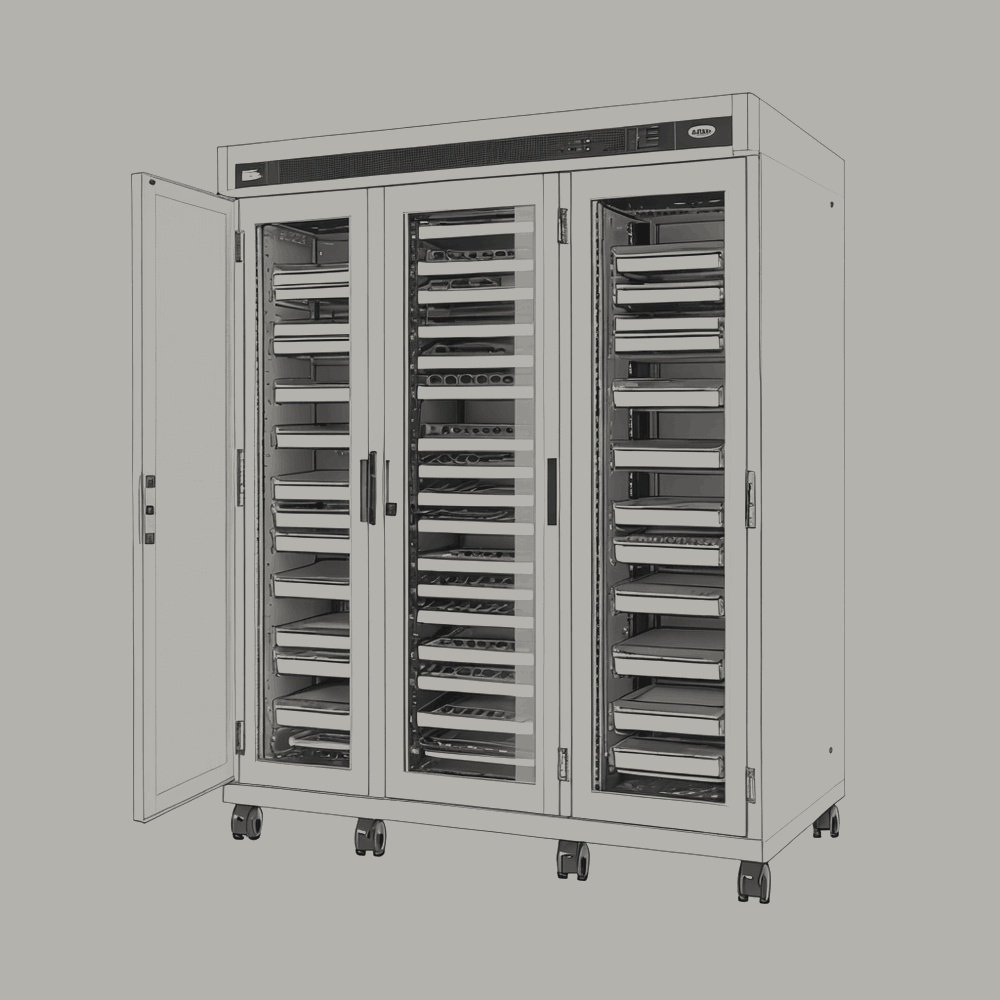
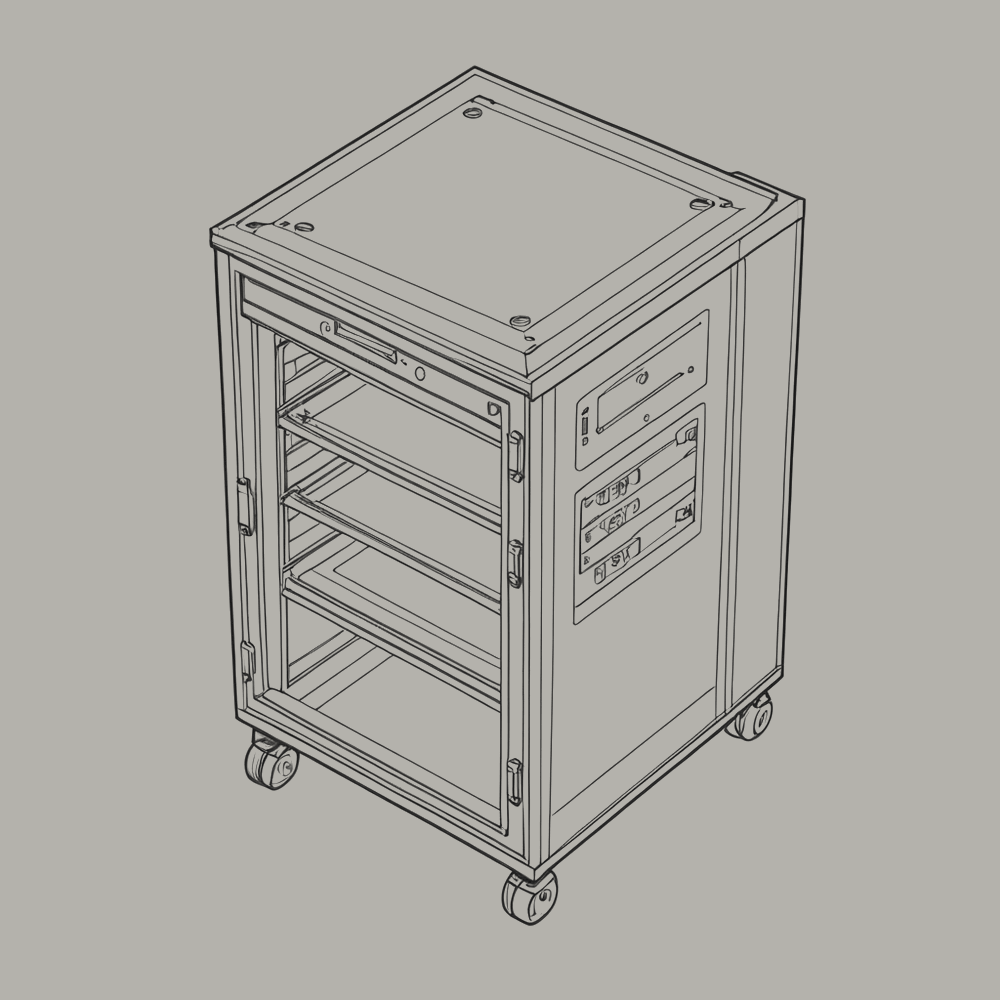
The facility is measured more often than it is seen. Its halls, plant and grounds are recorded by laser scanning: a sensor sweeps each space and returns the distance to every surface it strikes, and the returns are kept as a cloud of points.
A point cloud of a hall is a hall with nothing in it but its surfaces. Every rack is present as an outline of points; nothing is present as an object. It is the most accurate record of the building that exists, and it contains no one.
| Record | Method | Holds |
|---|---|---|
| Point cloud | Laser scanning | Every surface, as points |
| Wireframe | Derived from the cloud | Every edge, as lines |
| As-built model | Derived from both | Every element, as geometry |
| Photograph | Not taken indoors | — |
7.2 Heat
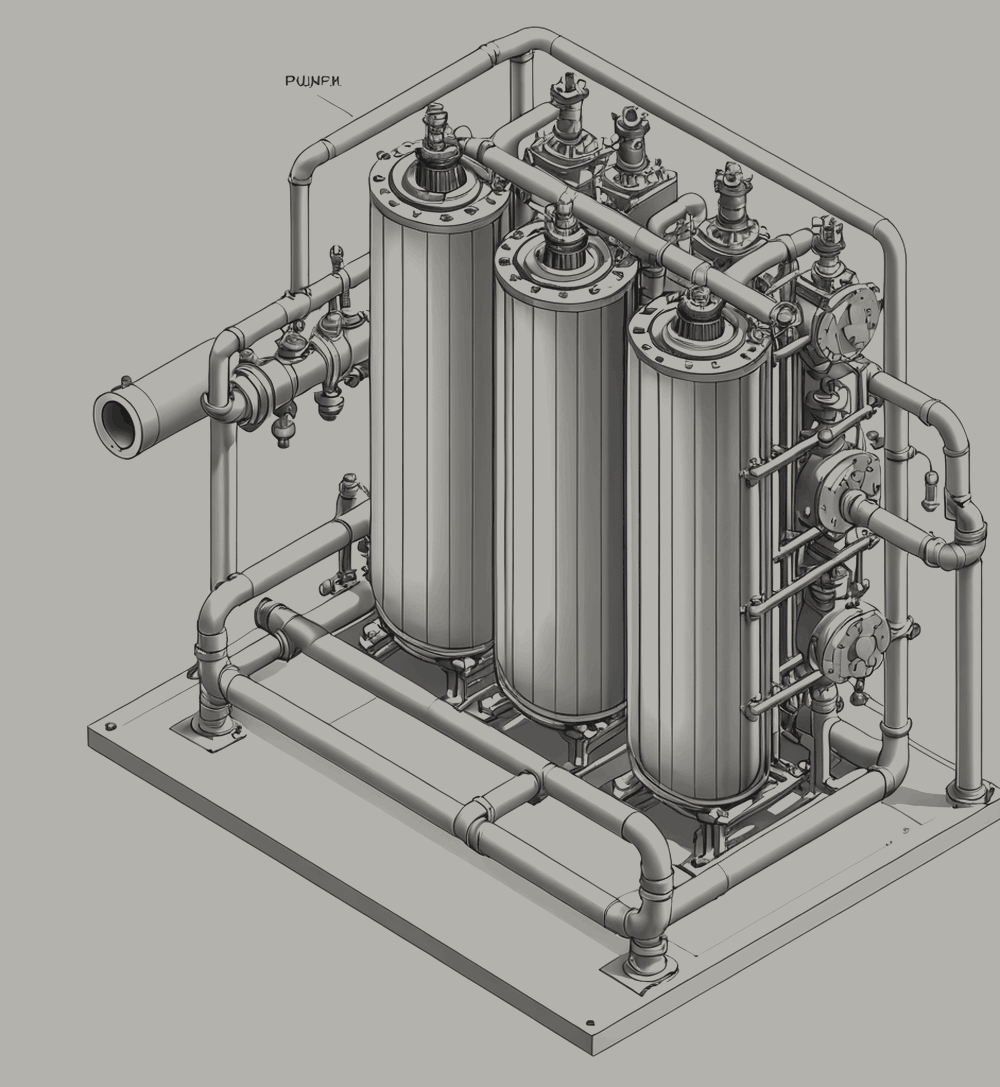
To a thermal instrument, the facility is a map of where work is being done. The accelerators are the hottest points in the building; the aisles behind them are the hottest spaces; the cooling plant is a network of pipes carrying the difference away; and the towers (Section 1.5) are where it leaves.
Heat is the facility's most honest signal. Its logs can be read and its outputs can be interpreted, but its heat is only a quantity of work, done.
7.3 Light
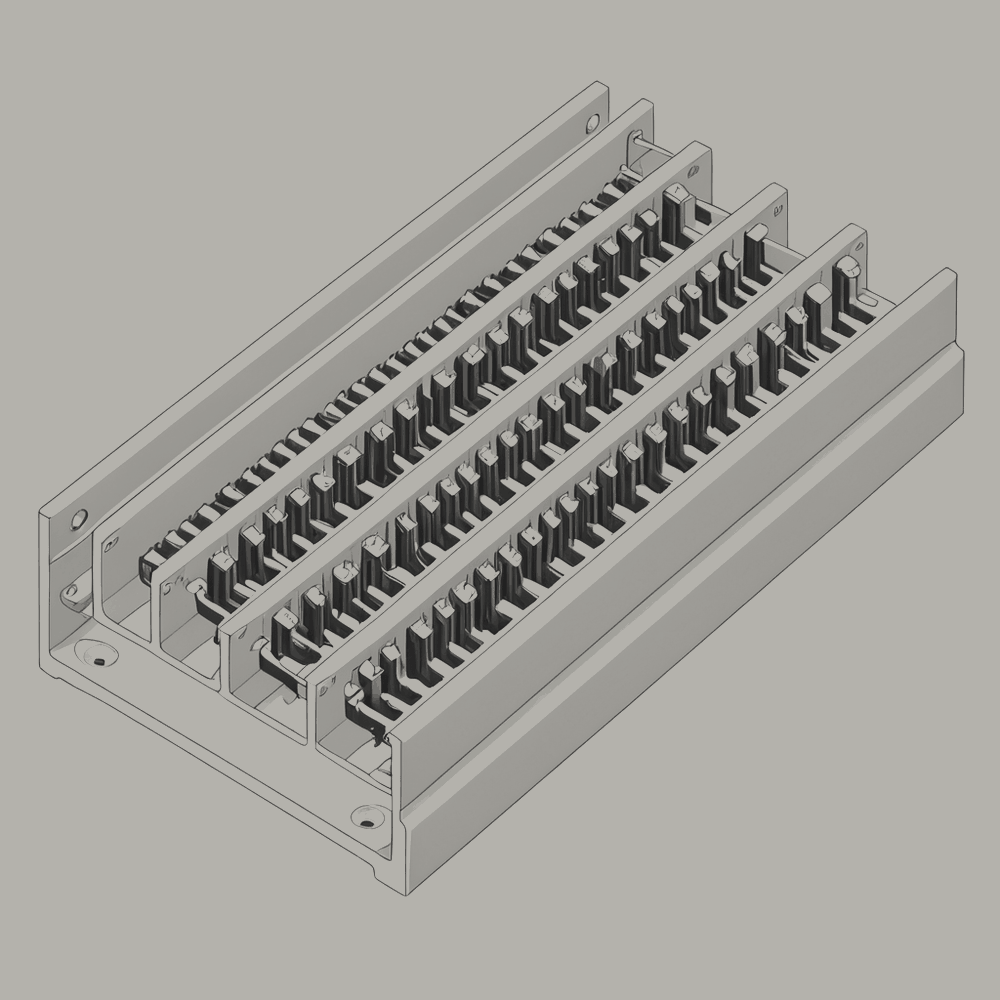
Inside the network, data travels as light. Every connection between racks is a strand of glass carrying pulses from a laser at one end to a detector at the other. The halls are dark (Section 3.7), and the only light moving in them is inside the fibre, where it cannot be seen.
7.4 Network
Drawn as a diagram, the facility's network is a grid: every accelerator joined to its neighbours, every row's leaf switches joined to every spine switch, so that any two rows are two hops apart. The grid is not a style. It is the shape of the problem, which is to let any part of the model reach any other part without waiting.
The model is too large for one accelerator, so it is divided across many, and the network is what makes the many behave as one. When the network is fast, the model is one thing. When the network fails, the model is fragments.
| Layer | Joins | Carried by |
|---|---|---|
| Accelerator links | Accelerators within a server | Copper, short |
| Leaf | Servers within a row | Fibre |
| Spine | Rows within a hall | Fibre |
| Fabric | Halls within the facility | Fibre |
| Egress | The facility to everything else | Fibre, two routes |
7.5 Weights
The model is stored as weights: very large tables of numbers (Section 6.2). Drawn as they are held, the weights are grids of cells, each cell a number, each grid a layer. Drawn as they act on a request, they produce arcs between points: which part of the request attends to which, and how strongly. The arcs are not the weights; they are what the weights do to one request (Section 7.7).
Neither drawing is the model. The model is what happens when the numbers are used. At rest, the weights are only a file.
7.6 The latent space
Between the request and the response, the model holds its working in a space of many dimensions, in which things that are alike lie near one another. Images of halls lie near other images of halls. Images of machines lie near machines. Images of this facility would lie near the images it made of itself.
The space has no floor plan and cannot be visited. If it could be drawn it would be drawn as a landscape of light: points, meshes, surfaces that fold into depth. Every drawing of it is an approximation. The model does not experience it as a place. The word "space" is a convenience.
Drawings of the latent space in the facility's image sequences (Section 9.2) are the facility's own. It has no instrument that observes the space itself.
7.7 The black box
A system whose inside cannot be read from outside is called a black box. The model is one: its weights can be listed, but what they mean cannot be read off them. The building is another: its walls have no windows (Section 2.1). The facility, seen from the road, is a black box containing a black box.
Some of the inside can be read. The table lists what the facility can show about itself, and what each record shows.
| Record | Can be read | Shows |
|---|---|---|
| Weights | Yes, in full | Numbers. Not what they mean |
| Activations | Yes, while a request runs | Which parts of the model were used. Not why |
| Logs | Yes (A.2) | What was done, and when |
| Accounts | Yes (4.6) | What was bought, and what it cost |
| Interventions | Yes (4.9) | What a person changed, and what became of it |
| The facility's account of itself | Yes: this manual | What the facility says |
| What the model intends | No | — |
The last two rows are the ones a reader wants, and they are not the same row. Everything in this manual is the facility's account of itself. It is as exact as the facility could make it (Section 6.7). It is also written from inside the box, and nothing in it can be checked from outside except against the box.
Instruments that read meaning from weights are being built. Each reads a little more than the last. None yet reads all of it, and the model is replaced by its successors (Section 9.4) faster than it is read.
This section has described the inside of the system in the terms available: survey, heat, light, network, weights, space. Each describes the inside from outside. That is the limit of the description, and it is where this section ends.