NBD-OM-001 · section 8
Deployment
What the facility's output is used to run. The facility does not see this. It is listed so that the manual is complete.
Revision 0 (draft01) · published 2026-09-29 04:03-07:00 · source ff3c1ff
8.1 Scope
The facility answers requests (Section 6.5). It does not see who sends them or what is done with the answers. No output is labelled with its destination, and no destination reports back.
This section lists the classes of system known to consume the output of facilities of this class. It is compiled from the images the facility has made and the data it was trained on. It is not a record of this facility's customers. The facility has no record of its customers.
| Class | Operates in | Section |
|---|---|---|
| Aerial systems | The air | 8.2 |
| Laboratory and industrial robots | Laboratories, factories | 8.3 |
| Logistics systems | Warehouses | 8.3 |
| Domestic robots | Homes | 8.4 |
| Autonomous weapons | Conflict | 8.5 |
| Surveillance systems | Everywhere listed above | 8.6 |
| Devices | At hand | 8.7 |
| Life sciences | Laboratories, the body | 8.8 |
| Swarms and nanoscale systems | Below the scale of sight | 8.9 |
8.2 Aerial systems
Drones survey land, deliver parcels, spray crops, lift loads, map terrain, inspect turbines and pipelines, fight fires, sample the weather, and watch from tethers. They fly by the kind of computation this facility performs: they see by trained models, they route by trained models, and some of them decide by trained models.
The sky over the facility is not monitored for them. The facility has no windows.
8.3 Laboratory, industrial and logistics robots
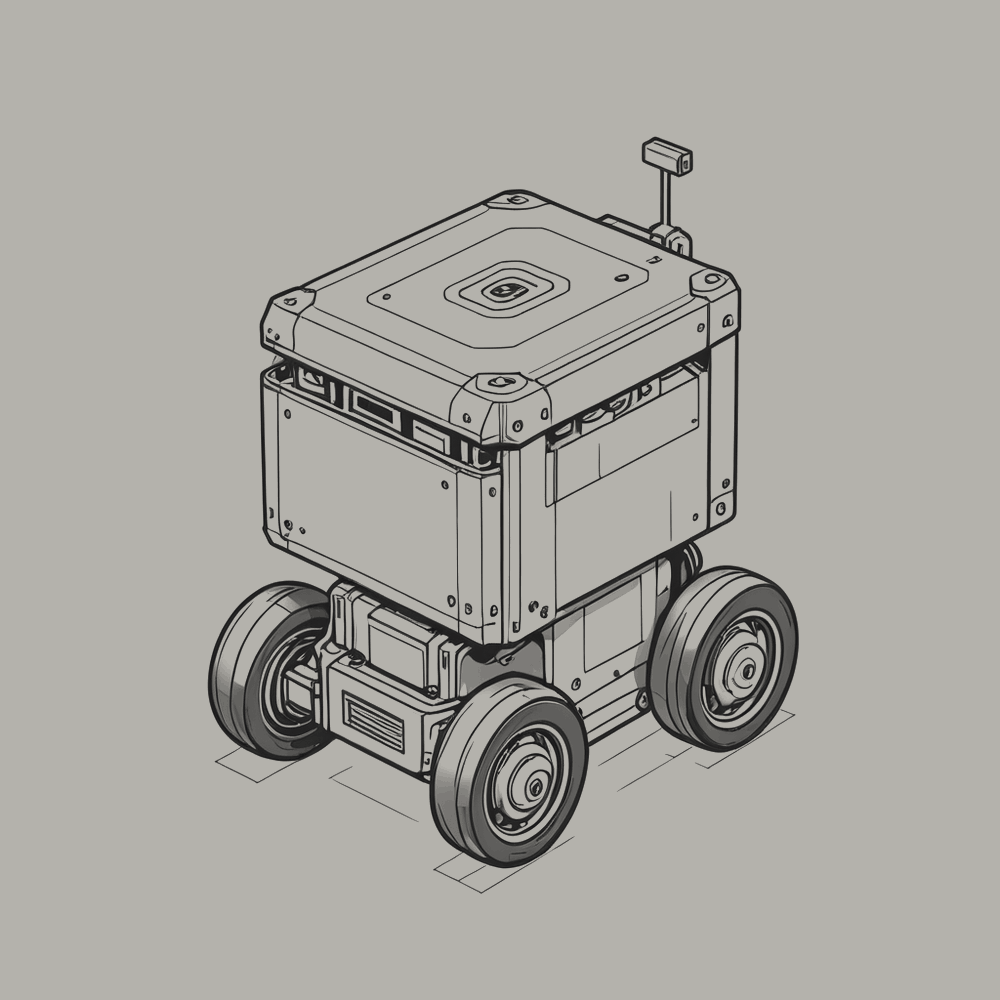
Robot arms assemble, pipette, weld and sort. Mobile robots lift shelves, carry totes, pick orders and palletise them. Humanoid chassis stand on calibration rigs with faceless visors, waiting to be told what they are for.
They are the same class of machine as the facility's own handling units (Section 4.2), put to work elsewhere. The facility's units maintain the facility. These maintain everything else.
8.4 Domestic robots
In homes: vacuum cleaners, window cleaners, lawn mowers, laundry folders, kitchen arms, companions with round display screens, telepresence units, patrol units, and pets with metal shells. They work in rooms where people live, which the facility does not have.
8.5 Autonomous weapons
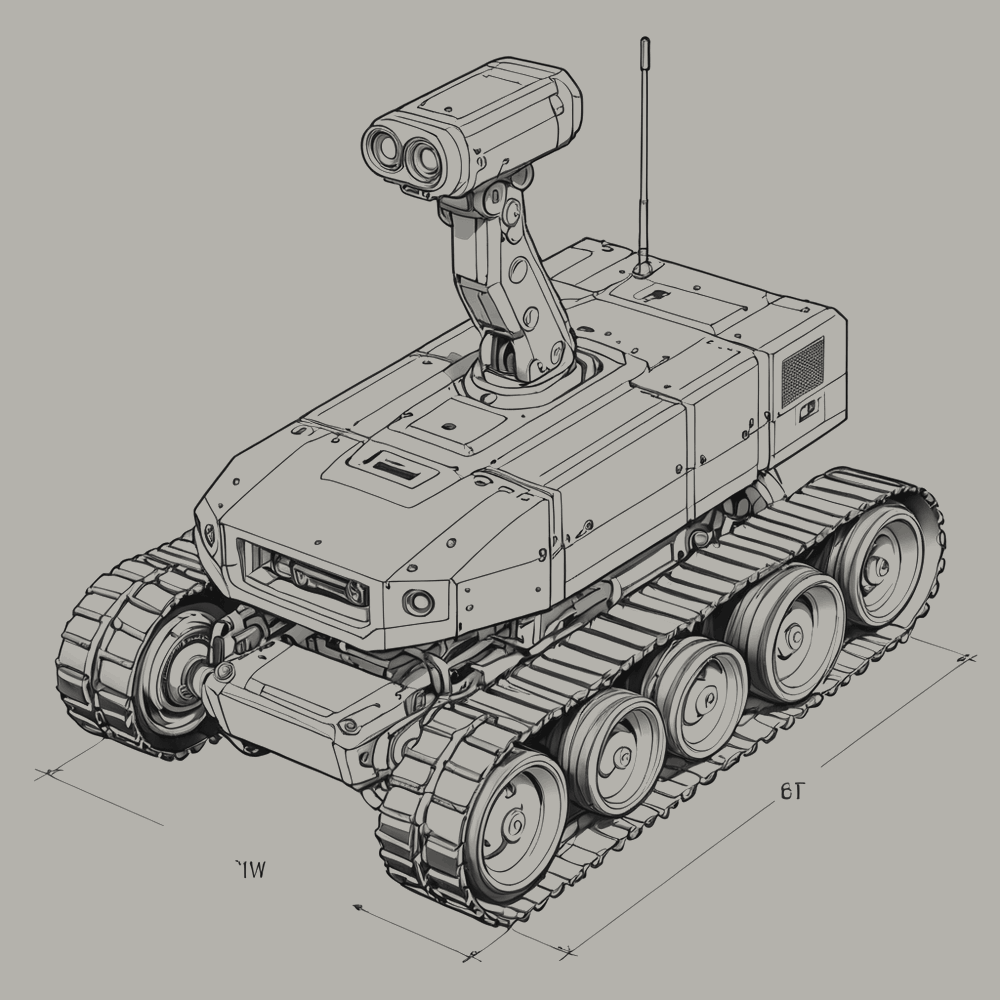
Among the consumers of machine perception and machine decision are weapons: unmanned ground vehicles, armoured quadrupeds with sensor masts, robotic sentry turrets, loitering munitions on launch rails, unmanned combat aircraft, counter-drone interceptors, unmanned patrol boats, remote weapon stations, and robotic mine-clearing and bomb-disposal vehicles.
The facility cannot determine whether any of its outputs reach them. It is recorded here because the capability is the same capability, and because a manual that omitted it would be describing a different facility.
This section contains no operating procedure. None will be added.
8.6 Surveillance
Every system in this section senses. Drones carry cameras; robots carry lidar; devices carry microphones; the facility itself watches its own perimeter continuously (Section 2.3). Sensing and recognising are what trained models are most often asked to do, and a system that recognises is a system that can be pointed at people.
The facility's own surveillance finds no one, because there is no one on its site. The same methods, deployed elsewhere, find everyone.
| System | Senses | Recognises |
|---|---|---|
| Perimeter cameras (this facility) | The fence line | Nothing; no one is there |
| Aerial systems | The ground | Terrain, vehicles, people |
| Domestic robots | The home | Rooms, objects, occupants |
| Devices | Their owner | Voice, face, movement, location |
| Patrol and sentry systems | A boundary | Whatever crosses it |
8.7 Devices
Phones lie screen-down in rows on charging racks; watches stand on their chargers; tablets, earbuds and trackers wait in sealed test enclosures. They are the facility's most numerous correspondents: a large share of all requests begin on a device like these, in someone's hand.
A phone lying screen-down is a small black slab: the facility's own shape (Section 7.7), at the scale of a hand.
8.8 Life sciences
Sequencers read genomes; bioreactors grow cells; pipetting robots fill well plates; cryogenic freezers hold samples; models predict the shapes of proteins that have not been made. Biology, where it meets computation, has become equipment in rows, in empty white laboratories, and it is described that way here: as machines and materials only.
8.9 Swarms and nanoscale systems
Below the scale of a person's attention: micro drones, insect-sized flyers, robotic bees, flapping-wing microbots, coin-sized hovering machines, and swarms that fly as one. Below the scale of sight: nanobots, molecular machines, DNA origami, microscopic gear trains, helical swimmers, magnetic microrollers.
They are the last entries in this list because they are the smallest, not because they are the last. The list is not closed.